Ice Ice Baby
An abstract Icehouce set collecting
and auction game for 2-4 players
(best with 3)
by Joss Ives
Version 1, August 29, 2005
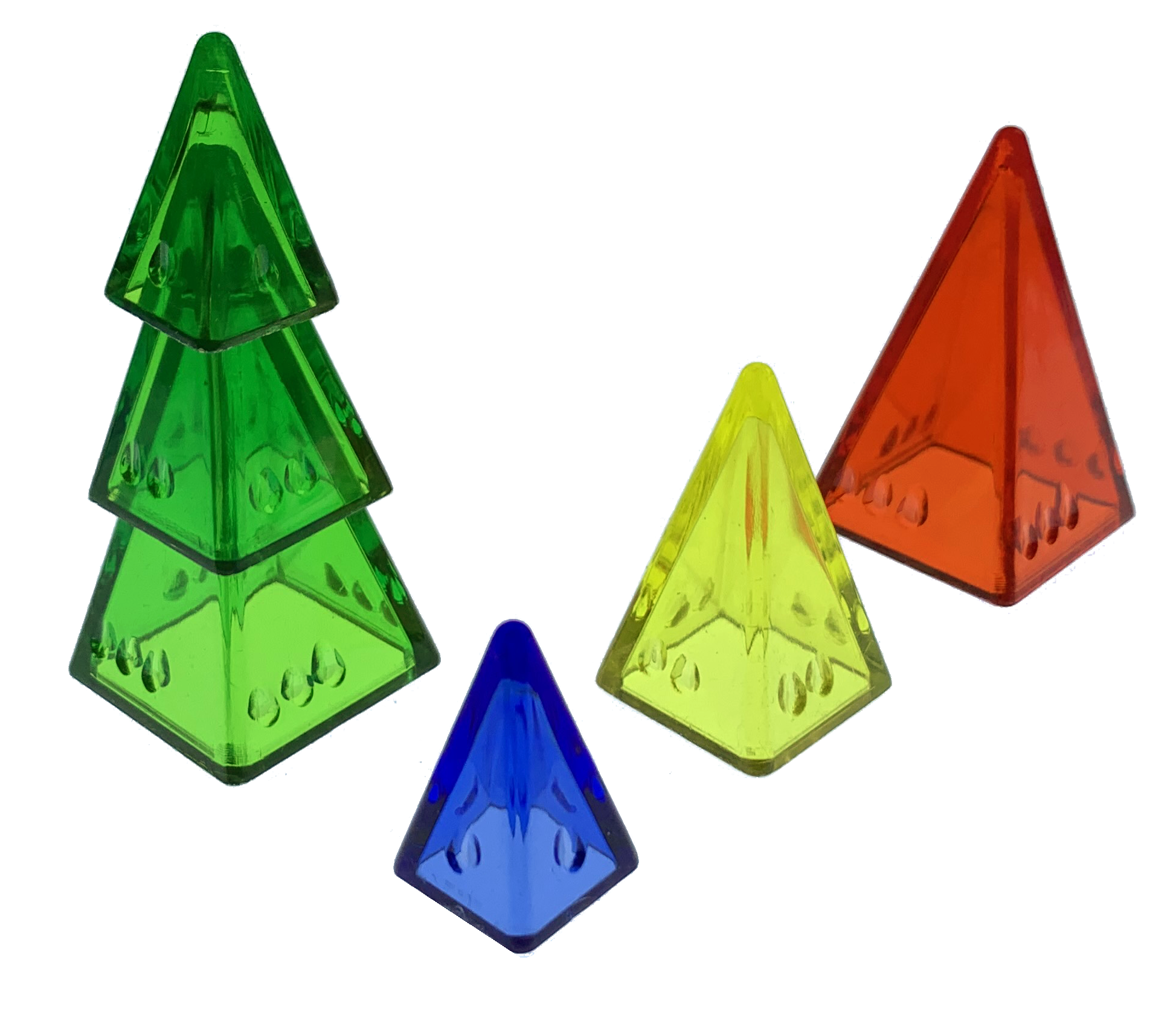
Summary: In this game, three
different sized pyramids of random colors are auctioned off each turn.
These pyramids are also the good with which bids are made and players
that bid at least one pyramid will all lose their bid, but in exchange
get to take bids of the next highest value. Everybody wins! At the end
points are awarded for having collected trees (one of each size of
pyramid) and bonus points to the players who have collected the most in
each of the colours.
This game
requires:
- Four different coloured
stashes and a bag to draw them from.
- A number of cards equal to the number
of players that are numbered from one up to the number of players are
very helpful to keep track of the order in which people have passed.
- The rules will assume you are using
these numbered cards and they will collectively be referred to as
passing cards and individually as number one, number two, etc...
- Dice can also be useful for this
task.
Summary of game play:
- Setup:
- Each player randomly gets a pyramid of each size in their
active area
- Randomly determine starting player
- A round:
- Starting player draws a pyramid of each size to put in auction
area
- Scoring pyramids are placed on the scoring track and replaced
with pyramid of the same size in the auction area
- Scoring round is triggered when total pyramids in scoring
area meets or exceeds 3,6,9 or 12 pyramids
- Starting player places first bid of one pyramid of any size or
passes
- Auction proceeds clockwise
- Players can pass or raise by at most one pyramid from the
last bid
- Value of bid is determined first by number of pyramids and
then pyramid size
- When a player passes they are out of that auction and take the
lowest numbered passing card left and place their last bid on that card
- If a player passes without having first made a bid, there are
not considered a bidding player
- The winner of the auction takes the highest card and the
auctioned pieces, and pays their bid to the last bidding player who
passed (player holding next highest numbered card)
- This player takes the winning bid and gives their own bid to
the bidding player who passed immediately before them (descending card
order)
- This continues until a player has no bidding player who passed
before them, in which case they take the bid passed to them and places
their own bid in the dead area
- If a scoring round was triggered, up to two players can make a
tree from pyramids in their active area and move it to their scored
area in exchange for pyramids from the dead area:
- Opportunity to do this scoring action is given to the winner
of the auction and if declined passes on to each player in descending
card order
- The first player who scores a tree gets two pyramids from the
dead area and the second opportunity to score continues on to players
in descending card order
- The second scored tree earns only one pyramid from the dead
area and no further trees can be scored during the current scoring round
- A player cannot score more than one tree per scoring round
- Player who won the auction is the starting player in the next
auction and all players give their passing cards back
- End of game:
- Game ends following the auction in which the 12th scoring
pyramid was drawn and added to the scoring track
- A regular scoring round occurs
- Afterward, all players make trees from the pyramids remaining
in their active area
- Final scoring for each player:
- 7 points - each uniformly coloured tree
- 5 points - each tree that is made up of two or more different
colours
- 1 point - each remaining pyramid that was not included in a
tree
- 5 point bonus awarded for each colour if player has the most
of that colour. In the case of ties, each player gets 3 points
The rest of the rules will describe
the summary of game play in more detail.
Setup:
- There are a number of areas on the
table, with the first three being common areas for all players and the
others being individual areas in front of each player:
- Scoring track (common):
- The scoring pyramids drawn thus
far. These should be arranged so that it is easy to tell when the total
number in this track is a multiple of three. This should be off to the
side, but easily viewable by all players. The game will end after the
auction in which twelve or more scoring pyramids are present in the
scoring track.
- Auction area (common):
- The current pyramids being
auctioned. This should be the middle of the table
- Dead area (common):
- This is where the pyramids that
have been used to pay for auctions go, this should also be off to the
side, but easily viewable by all players
- Active area (each player):
- Each player will have an
active area which will consist of all of that players pyramids that are
currently eligible to be used for bidding. The active area should be
directly in front of them. Pyramids in the active area should never be
stacked.
- Scored area (each player):
- During the game, there will be
multiple scoring rounds in which players will have the opportunity to
make trees (a set of each size of pyramid) from the pyramids in their
active area and move these trees to their scored area, where they will
still count toward that player's final score, but these pyramids are no
longer eligible to be used for bidding, nor can they be rearranged to
make higher scoring pyramids later in the game. Once a tree has been
moved to the scored area, it is locked in that configuration for the
rest of the game. In exchange for making a tree and moving it to the
scored area, players will have the opportunity to recover pieces from
the dead area. Each player's dead area should be in their individual
playing areas, but further away from the center of the table than the
active area. The active and scored areas are easy to differentiate from
each other as the scored area will be made up of only trees and the
pyramids currently in the active area are never stacked.
- Choose one of the four stash colours as the scoring colour.
- If using the Zendo
set, red makes an excellent scoring colour.
- Put the three
non-scoring pyramids in the bag and mix them up well.
- Each player draws
a pyramid of each size such that each player will start the game with
three randomly coloured pyramid, one of each size.
- If the scoring
colour was already included in the bag, players draw until they have
one of each size of pyramid that is not a scoring colour and all of the
scoring coloured pyramids that were drawn are placed back in the bag
and mixed in well.
- Each player puts their three starting
pyramids in front of them, in their active area.
- Randomly determine who will be the
starting player.
- The easiest way is to randomly deal
out the numbered cards and the player receiving the highest card will
start.
Outline of game
play:
- Each round will begin with the current
starting player drawing a pyramid of each size from the bag.
- Any pyramids of the scoring that are
drawn are placed in the scoring track and a
pyramid of that same size is drawn to replace it in the auction area.
This will continue until the area is made up completely of pyramids
that are not of the scoring colour. At the end of
the game, there is a chance that there will not be enough pieces to
make up the auction area of three. This special case will be discussed
later.
- Each time that the total number of
scoring pyramids that has been drawn reaches or passes a multiple of
three (3, 6, 9 or 12), a scoring round will follow the current auction.
- After the auction area consists of
three non-scoring coloured pyramids, and all the scoring coloured
pyramids have
been placed in the scoring track, an auction will occur.
- The player who wins the auction will
become the starting player for the next round. Details of how auctions
work will be discussed later.
- The final scoring round will occur
after the auction in which twelve or more pyramids were present in the
scoring tracks. This will usually be the fourth scoring round, but not
always.
The Auction:
- Each round will consist of an auction,
which will sometimes be followed by a scoring round.
- Reminder: a scoring round is
triggered when scoring pyramids are drawn (when making up the auction
area) such that the number of pyramids in the scoring track
reaches or exceeds a multiple of three (3,6,9 or 12).
- The current starting player begins the
bidding by either passing or bidding one pyramid of any size.
- A bid of zero is not a valid bid.
- Reminder: pyramids in players'
active areas are the only ones that they can use for bidding, the trees
in their scoring area cannot be used for bidding.
- Each player can either pass or make a bid which is higher than the last placed bid with
a restriction of being able to only make bids that have at most one
more pyramid than the last placed bid (a player can only raise by a
maximum of one pyramid).
- Bidding values
are described below.
- When making a new bid, a player is not
obligated to use the pyramids from their last bid.
- The first player to pass will take the
lowest numbered bidding card (the card numbered one) and place it in
front of them.
- When a player passes, they will
place their last bid from the current round on their passing card
(recall the numbered cards are collectively referred to as passing
cards)
- No pyramids on a player's passing
card indicates they passed before making a bid and are not considered a
bidding player
- Remember that zero pyramids is not
a
valid bid.
- The next player to pass will take the
next highest card and so on, with all players placing their last bid
before they passed on their passing card.
- The winner of the auction:
- Takes the highest card and places the
pieces which were being auctioned in their active area
- Pays their bid to the last bidding player who
passed (player holding next highest numbered card)
- This player holding the next highest numbered card:
- Takes the winning bid and places it in their active are
- Gives their own bid to
the bidding player who passed immediately before them (descending card
order)
- This continues until a player has no bidding player who passed
before them, in which case they take the bid passed to them and places
their own bid in the dead area.
- Remember that a player who has passed before making a bid is
considered a non-bidding player.
- In the very rare case that all players
but one passed without bidding, that last player will simply place
their bid in the dead area and take the auction area pyramids and place
them in their active area.
- After the auction has been completed,
a scoring round will occur if it was triggered when making up the
auction area by having the score track reach or exceed a multiple of
three pyramids (3,6,9 or 12). In the case of twelve or more pyramids in
the scoring track, the game end is triggered.
Bidding values:
- The value of a bid is given first by
the total number of pyramids in the bid and next by the sizes of the
pyramids in the bid.
- Colours
have no effect on the value of the bid, only sizes and total pyramids.
- A large is worth more than a medium
pyramid and a medium is worth more than a small.
- When bids have equal numbers of
pyramids, the bid with the most large
pyramids is considered the largest. If they both have the same number
of large pyramids, the bid with the largest number of medium pyramids
is considered the larger.
- Examples:
- A bid of three small pyramids is
worth more than two larges (larger pyramid count).
- A bid of a large, a medium, and two
smalls is worth more than four mediums (same pyramid count, but more
large pyramids).
Triggering
scoring
rounds:
- Following an auction in which scoring
pyramids were drawn such that the number of pyramids in the scoring
track meets or passes a multiple of three (3,6,9,12) there will be a
scoring round
- If enough scoring pyramids are drawn
such that the scoring condition is met more than once, only one scoring
round is triggered and their will be one less scoring round in the game
- Example: There are 8 pyramids in the
scoring track (there have been two scoring rounds already) before
drawing pyramids for the current auction area. While drawing pyramids
for the auction area, enough scoring pyramids are drawn to bring the
number of pyramids in the scoring track up to twelve. When the twelfth
pyramid had been drawn, this indicates this will be the final auction.
Although pyramids were drawn to meet the scoring round condition twice
(at nine and again at twelve), there is still only one scoring round
following the auction in which these pyramids were all drawn. If more
scoring pyramids are drawn after the twelfth, they are placed with the
scoring track with no effect.
- If the pyramids in the bag are
completely depleted and the current auction area is not full (there are
not three pyramids in it), pyramids of the scoring colour
are used to fill the sizes that are not needed. These pyramids are
considered colourless and if won can only
be used in non-uniform coloured trees (5pt
trees) or as single 1pt pyramids. The scoring colour
is never used to determine bonuses awarded to the player with the most
pyramids of a single colour
Scoring
rounds:
- Following an auction in which scoring
pyramids were drawn such that the number of pyramids in the scoring
track meets or passes a multiple of three, there will be a scoring round
- It is important to note the following:
- The term scored refers to moving a
tree from the active are to the scored area and not to actually
tabulating any points. The tabulating of points is only done at game
end.
- A player cannot score more than one
tree in a given scoring round.
- No more than two player can score a
tree in a given scoring round.
- After the auction has been completed,
the player who won the auction has the opportunity to move a tree to
their scoring area in exchange
for pyramids. They will make a tree from the pyramids in their current
active area (uniform colour/5pt or multi-colour/7pt) and move the tree
to their scored area. In
exchange that player gets to take any two pyramids from the dead area.
If there are not two pyramids in the dead area, they take only as many
as there are
- If the player who won the auction
declines to score a tree, the next highest numbered card is given this
opportunity and so on.
- After a player has scored a tree in
exchange for two pyramids from the dead pool,
the player with the next highest card is given the opportunity to score
a tree for one pyramid from the dead area.
- Once a second player has cashed in a
tree, no other players can cash in any trees during that scoring round
- After the scoring round, another
auction area is drawn from the bag and play continues. It is possible
that scoring rounds are triggered in consecutive auctions
Final
scoring:
- After the final scoring round (after
the auction in which at least the twelfth scoring pyramid was drawn)
each player makes trees from the pyramids remaining in their active
area. The trees in their scored area are not allowed to be disassembled
to make higher scoring trees. Each tree that is a uniform colour is worth 7 points and trees that contain
more than one colour are worth 5 points.
Any remaining pyramids are worth one point each
- Five bonus points are assigned for
each colour to the player with the most
pyramids of that colour. In the event of a
tie between two or more players, each of the tied players receives 3
points.
- The player with the most points at the
end is the winner
- The tie breaker is determined by the
bidding value of each of the tied players
total collected pyramids.
- i.e. the
player with the most pyramids will win the tie breaker. If both players
have the same number of pyramids, the tied player with the most large pyramids wins the tie-breaker, and so
on.
Variant
for a shorter game (especially good for 2 players):
- This variant is primarily for 2 players, but can serve as a
shorter game for any number of players
- The game is played exactly as normal except that scoring rounds
are triggered on multiples of two instead of three
- i.e. following the auction in which pyramids were added to the
scoring track and the number in the scoring track has met or exceeded
2, 4, 6 or 8 pyramids, there will be scoring round.
- Note that it is quite likely that there will be less than four
scoring rounds due to a number of scoring pyramids being drawn during a
single round such that the scoring trigger condition is met more than
once in a single round. Recall that when this occurs, only a single
scoring round occurs.